7 Signs Your Business Process Is Ready for Improvement

A process is ready for improvement when it really lives in email, only moves when people chase each other, gives no visibility over what is open, forces the same information to be entered several times, or depends on one person. Start where the business impact is significant and the implementation effort remains manageable.
A process can be well documented, responsibilities clearly assigned and business systems firmly in place. Yet the actual work still often happens somewhere between email, Excel and a message to a colleague: "Can you just check where this stands?"
Imagine a perfectly ordinary Monday morning.
A request arrives in someone's inbox. The information is copied into Excel and an attachment is saved to a shared folder. The document is forwarded to a colleague for approval. Two days later, someone sends a reminder because there has been no response.
Meanwhile, during a management meeting, someone asks: "How many open cases do we currently have?"
The answer? "Give me a minute, I need to check."
One person opens an Excel file. Another checks their own records. A third colleague gets a call because some of the information exists only in their spreadsheet.
None of this looks like a major problem. The work got done yesterday, and it will probably get done tomorrow as well.
And that is exactly the problem.
Once this way of working becomes normal, we stop noticing it. A few minutes spent retyping information. Five minutes checking a status. One reminder message. Half an hour preparing a weekly report.
Multiply that by dozens of employees, hundreds of requests and twelve months, and suddenly you are looking at a very real cost.
So the right question is not "What could we digitalise?". A better question is:
Where are we unnecessarily losing time, information or visibility today?
If you recognise your organisation in any of the following seven signs, the answer may be closer than you think.
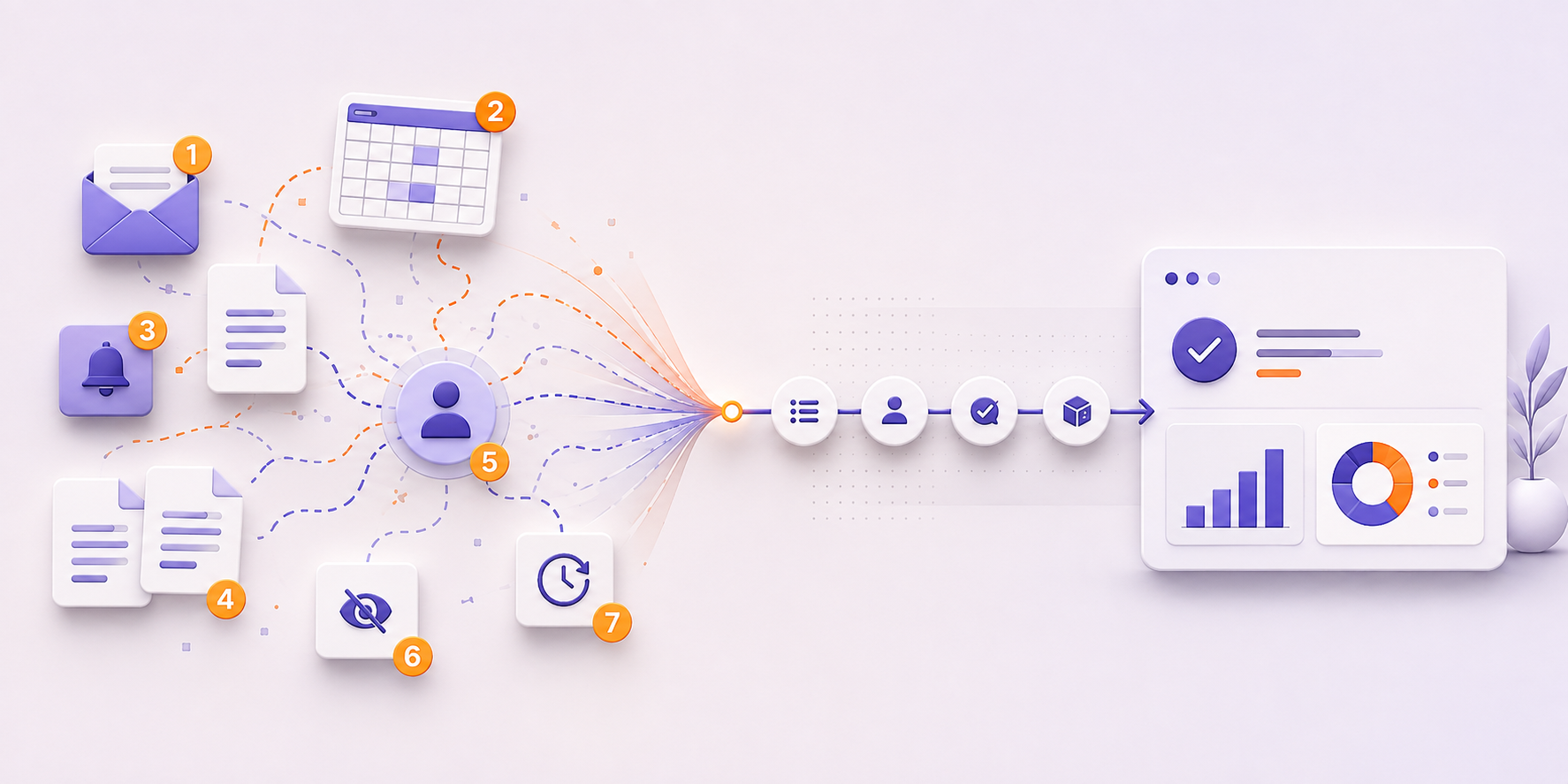
1. The process is well documented. In reality, it lives in email.
On paper, everything is clear. A request is submitted. The responsible person reviews it. Approval follows, then execution and closure.
In reality, the request arrives by email. Someone forwards it. The next person replies only to the original sender. Part of the communication remains buried in a personal inbox. The attachment ends up with file names such as final, final2 and really-final.
A week later, someone asks: "Has this been sorted out yet?"
The process exists. What is missing is a system that actually manages it. That is an important distinction.
Digitalising a process does not simply mean replacing paper with an electronic form. A good process should be able to answer a few basic questions at any moment:
- Where did the case start?
- Where is it now?
- Who is responsible for it?
- What happens next?
- When is it complete?
If employees have to reconstruct those answers from an email thread, the process is a strong candidate for improvement.
2. Nothing moves unless people remind other people
"I've already sent it to him." "I'll remind her again." "We're still waiting for approval." "Can you check who has it?"
If you regularly hear sentences like these, you are looking at one of the clearest signs of process inefficiency.
Of course, every process includes some waiting. Someone has to review a request, approve something or make a decision.
The problem starts when moving the process forward depends on one person repeatedly chasing another.
In many internal processes, a system could handle these routine tasks automatically: notify someone when they receive a new task, send a reminder after a defined period, escalate overdue items and notify the next person once the previous step is complete.
None of this is revolutionary technology. But these are often exactly the kinds of small improvements that make employees say a few months later: "How did we ever work without this?"
3. No one can quickly answer: "What is currently open?"
During a meeting, a manager asks: "How many open cases do we currently have?"
If the answer starts with "give me a moment, I need to check the spreadsheet" or "I know about our department, but I'd have to ask the others" or, perhaps most worryingly, "it depends on whether everyone has updated their data", then the real problem is not reporting.
The problem is that the organisation lacks visibility over the process.
Visibility is not something management needs only once a month for a report. It affects everyday decision-making.
If we can see open cases, their statuses, responsible people and the time each case has spent in a particular stage, we can quickly identify bottlenecks, recurring delays and areas where workloads are becoming uneven.
Without that visibility, organisations often manage processes largely by instinct. And instinct is a rather expensive information system for running a business.
4. The same information is entered three times
A customer or employee fills in a form. Someone receives the information by email and enters it into Excel. Another person later copies it into the main business system. The same information is then used again in a report.
Once we become used to working this way, it hardly seems unusual. But every manual re-entry of data creates three very real costs: time, the possibility of error and uncertainty over which version of the information is correct.
One of the fundamental principles of a good digital process is therefore very simple:
Capture information once, as close to its source as possible, and reuse it throughout the process.
This does not necessarily mean replacing your ERP, CRM or other core business system. In fact, some of the biggest opportunities for improvement are often found between existing systems - in those small gaps where people are currently doing work that a custom solution could do for them.
5. Reports are still something we build instead of something we have
Monday morning. Someone sends an email: "Please send me your figures for the monthly report."
Excel files start arriving. Someone combines them. Checks the formulas. Calls a colleague because one figure is missing. Creates a chart. Sends the report to a manager. The manager asks for one more change.
A month later, the entire process starts again.
The question is not whether Excel is a good or bad tool. Excel can be an excellent tool. The more interesting question is: why are we rebuilding information every month if it could be generated continuously as a natural by-product of the process itself?
When process data is captured in a structured way as work happens, reporting no longer needs to be a separate process. It becomes a view of the current situation.
A manager no longer has to wait until Friday to understand what happened by Thursday. They simply look.
6. The process works perfectly - as long as the right person is at work
Almost every organisation has someone like this. "Ask Sarah. She knows how it works."
And Sarah really does know. She knows which exception applies to which customer. She knows who needs to receive which document. She knows what a particular abbreviation in the spreadsheet means. She even knows where to find that file from 2022 that the team still occasionally needs.
People like Sarah are extremely valuable to an organisation.
But if a process works primarily because one person keeps everything in their head, personal spreadsheet or email inbox, the organisation also has a significant operational risk.
It usually becomes visible only when that person is on holiday, off sick, changes roles or the team begins to grow.
Good digitalisation is not about replacing employees' expertise. Quite the opposite. It is about removing unnecessary administration around that expertise and ensuring that the basic process, information and responsibilities are not dependent on who happens to be in the office that day.
7. Everyone knows things could work better. No one knows where to start.
This may be the most common sign of all.
Management sees opportunities. Finance has its own list of pain points. HR has three processes it would like to improve. Operations has five. IT has a backlog that is longer than the time available to address it.
And then AI enters the conversation. At the next meeting, someone asks: "Shouldn't we be doing something with AI as well?"
Suddenly, there are so many ideas that nothing happens.
In this situation, one simple shift can make a significant difference. Do not start by choosing the technology. Start by listing the problems.
Which process should you improve first?
Not every inefficient process is a good first project.
A process that frustrates three people for five minutes once a year is probably not your highest priority. A process where 40 employees spend ten unnecessary minutes every day is a very different story.
When choosing where to begin, ask five questions.
1. How often does the process occur?
Do not look only at how long one instance takes. Consider frequency and the number of people involved.
2. How much manual work does it contain?
Look for retyping information, copying data between systems, emailing attachments, checking statuses, sending reminders and manually creating documents or reports.
3. Do we have visibility over the process?
Can you immediately see what is open, who is responsible and where cases most frequently get stuck?
4. How many people or departments are involved?
Every handover between teams is a potential point of delay, misunderstanding, lost information or duplicated work.
5. What would improving the process actually mean for the business?
Less time spent on administration? Fewer errors? Faster response times? A better customer or employee experience? More control? Lower operational risk?
The best first project is usually not the biggest or most ambitious one. It is the one where the potential business impact is significant and the implementation effort remains manageable.
Digitalisation no longer has to mean a multi-year IT project
For many managers, the word digitalisation still carries quite a lot of baggage. A lengthy specification. A new information system. Months or years of development. A large investment. And a long wait before anything actually improves.
Projects like these still exist and, in some cases, they are necessary. But many everyday process problems no longer require replacing core business systems.
Especially in organisations already using Microsoft 365, many gaps can be addressed gradually. One process. One concrete problem. One application or automation. One result. Then the next step.
A solution can capture structured information, automate notifications and approvals, connect existing data sources and give managers real-time visibility over what is happening. Our case studies show what that looks like in practice.
The technology is not the most important part of the story. Choosing the right problem is.
And where does AI fit into all of this?
Today, almost every conversation about improving business operations eventually turns to artificial intelligence. And rightly so.
AI can create real value when working with documents, searching for information, summarising content, classifying data, preparing drafts, supporting communication and helping people make decisions.
But there is a trap. AI does not fix a poor process simply because we add AI to it.
If responsibilities are unclear, information is scattered across five different places and nobody can clearly explain how the process is supposed to work, AI may simply help us perform a poorly designed process faster.
That is why the order matters:
Understand the process → Remove unnecessary steps → Structure the data and digitalise the workflow → Add AI where it creates value
Process first. AI second.
You can start at your next management meeting
You do not need a company-wide digital transformation programme, a project office or a three-month analysis to take the first step. Try something much simpler.
At your next management meeting, ask department heads and key process owners one question:
Which process or task currently takes up a disproportionate amount of your time, requires too much coordination or gives you too little visibility?
Ask everyone to write down three answers. Put them on one list and evaluate them using only two dimensions: what business impact improving the process would create, and how difficult it would be to implement.
A useful picture will emerge surprisingly quickly. Some issues will turn out to be minor everyday annoyances. Some processes will be strategically important but too large to tackle as a first step.
And a few will fall exactly where you want them: high potential with a manageable level of complexity.
Your best digitalisation ideas are probably already inside your organisation
The best ideas for digitalisation rarely come from browsing a catalogue of new technologies. They come from everyday work.
From the manager who lacks visibility. From the employee entering the same information into three different systems. From the colleague spending two hours every Friday preparing a report. From the process owner constantly checking who still has not responded.
These are small moments that are easy to accept as simply part of the job. Until one day someone asks:
Why are we still doing it this way?
Technology comes later. The first step is recognising that moment as an opportunity for improvement.
Not sure which process to start with?
At BizIT, we run a 90-minute in-house workshop for management teams and key process owners, designed for organisations that know there is room for improvement but have not yet identified the right first digitalisation project.
We do not begin with a presentation of technology. Instead, we use concrete business examples to show what is possible today. Together with participants, we then identify process improvement opportunities within their organisation and define the first priorities.
Business problem first. The right solution second.
Let's talk about your process
In the introductory consultation we look together at which process is most worth improving first in your organisation.
Book a consultation